
#1046 Everyone was game jam vibe-coding
YGG joins MapleStory, The Sandbox, Gigaverse etc
In retrospect, it makes complete sense.
Decentralized authority and ownership of digital assets have always been central to blockchain gaming’s vision. But ownership means little if players cannot do anything meaningful with those assets beyond holding, trading or selling them.
Without agency, blockchain gaming is reduced to little more than a speculative investment scheme, as its recent history has demonstrated.
Ownership and agency therefore have to coexist. Players need to own their assets, but they also need the ability to use them to create new content, experiences and games without remaining entirely dependent on the original developer.
We are not there yet. But the rise of vibe-coding is the first time blockchain gaming has had a credible route toward fulfilling that vision, because it dramatically lowers the technical barrier between owning an asset and building something with it.
This also helps explain why a growing number of blockchain gaming companies are organizing their strategies around player creation — and why I expect every serious onchain project eventually to launch some version of it.
EVE Frontier provided an early indication of the direction in March with its first hackathon, which, although not AI-branded, was predominantly vibe-coded, notably by the overall winner, who wasn’t even typing prompts, just talking to ChatGPT.
This was followed by Gigaverse’s GIGATHON #1 and MapleStory Universe’s recently completed Vibe Camp, which generated 693 projects using the fabled franchise’s IP.
The Sandbox’s first AI game jam is still running, while YGG is preparing the inaugural game jam for its newly launched vibecode.game platform in partnership with Animoca Brands’ Minds.
Now, these initiatives are not all doing exactly the same thing. Some are integrated with onchain assets, and generating yield whereas others are just about using AI to make mini-games, no blockchain required.
But collectively, the direction of travel is that blockchain gaming is shifting from asking players to own parts of a game towards giving them the tools to extend it.
Even games without formal game jams and prize pools are finding out that their users will build things anyway.
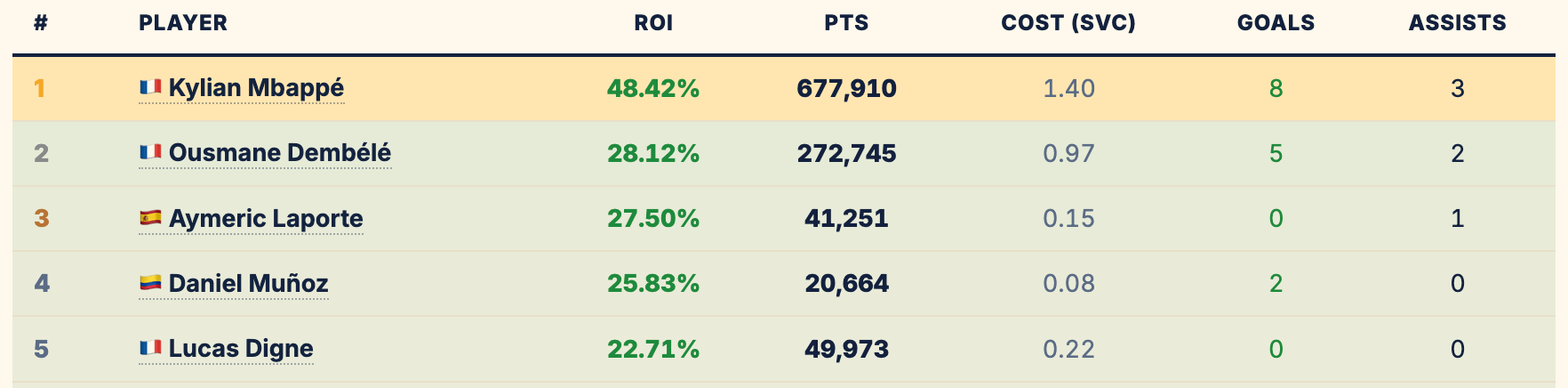
Soccerverse’s World Cup-adjacent Grand Tournament is one example, as is my own modest contribution, SVC Showdown: an external game built around Soccerverse player ownership and real-world World Cup performances.
Its player leaderboard has predictably been dominated by the goal-scoring antics of Kylian, Lionel, Erling and ’Arry. The player ROI leaderboard, however, has thrown up some rather more interesting names.
🔗 Additional Links 🔗
YGG shuts down YGG Play, pivots to AI gaming data.
GFAL’s Diamond Jewels Match hits 100,000 downloads on Google Play.
WEMIX token now live on Kraken.
Ethereum is rebuilding with privacy and quantum-resistant key features.
The top 50 players in high-risk, high-reward game Cambria spent $1.05 million.
More at YouTube | Spotify | X | RegenRaygun